How far does a beam bend?
The classic formula for a loaded beam, checked with a few lines of code.
· 1 min read
Put a weight in the middle of a plank resting on two bricks and it sags. How much it sags depends on four things: the load , the span , the stiffness of the material , and the shape of the cross-section .
The formula
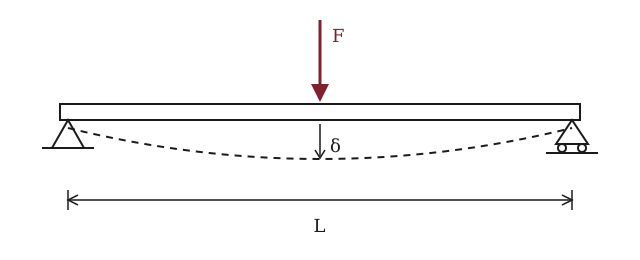
For a simply supported beam with a point load at mid-span, the deflection at the centre is1
The cube on is the surprise: double the span and the beam sags eight times as much. For a rectangular section of width and depth , the second moment of area is , so depth matters far more than width.2
Checking it in code
// Deflection (m) of a simply supported beam with a central point load.
function deflection(F: number, L: number, E: number, I: number): number {
  return (F * L ** 3) / (48 * E * I);
}

const I = (0.1 * 0.02 ** 3) / 12; // 100 mm × 20 mm pine plank, laid flat
console.log(deflection(500, 1.0, 10e9, I)); // ≈ 0.0156 m: about 16 mm
Stand the same plank on its edge and becomes 100 mm. The deflection drops by a factor of 25.